
I have both introverts and extroverts in my home. My kids have had their moments (and, like anyone else, we have plenty of struggles, as evident by my blog posts), but for the most part, they respect authority, as far as anyone outside the home is telling me. They get good marks for citizenship. They are not disruptive in class.
But they are among the silent, unrewarded in the current society.
Why?
Because they are “consistent behavers.”
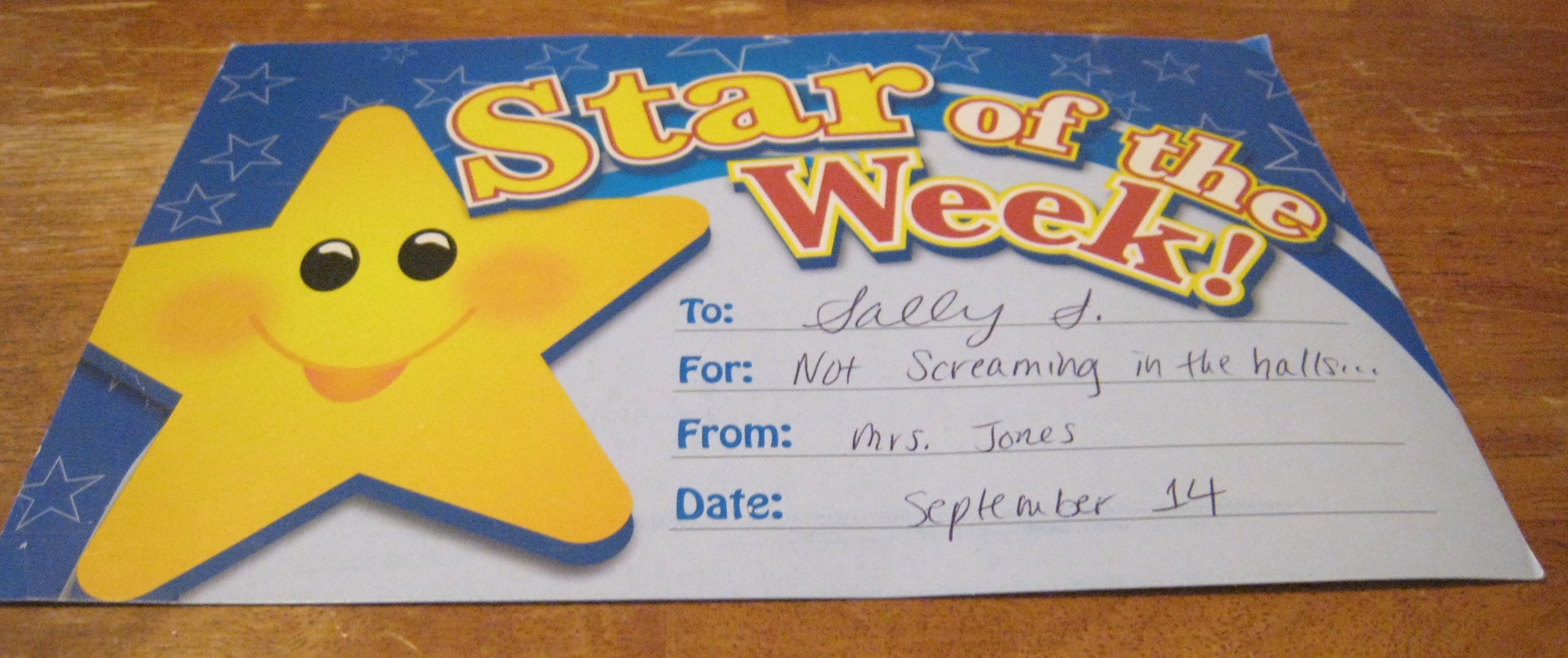
The school is filled with them. But they are not the ones getting the reward cards and certificates for behaving well. Not most of the time. Most of the time, the more behaviorally inappropriate kids are rewarded when caught in the act of good behavior because the adults who work with them are so relieved there was a good moment, and they want to positively motivate them.
That’s not a bad thing, necessarily. I am all for positive motivation. I’m not actually wishing for rewards for my kids. I’m just concerned about what they’ve come to mean.
What about those kids who are already being respectful 90 percent of the time or more?
We have found, in our family, that they are just expected to keep being behaviorally awesome with little to no reward. It becomes an expectation on them, an assumption.
And I think good behavior should be an assumption. I don’t think we should get a reward for sitting quietly in class when we are 11 years old. But why is it not where the bar is also set for the kids who act out more regularly? Their bar is set lower. If they are respectful 4 out of 10 times, they get the figurative cookie.
I have watched this play itself out over and over again in several settings lately, and it’s appalling to me every time. Just as not getting noticed for improved behavior can be disheartening for a child really trying to do better (I believe in recognizing that), consistently not being acknowledged (even a quick word of praise) can also be very discouraging to children already achieving good behavior. It doesn’t matter if it’s school or an after-school activity, Jenny Do-Right watches Betty Act-Out get coins, candy, stickers, a reward certificate, first in line, etc., when she makes a right choice.
Jenny Do-Right quietly offers these same expected, correct behaviors 9 or 10 out of 10 times, and she often receives no recognition.
Honestly, one of the few places I *do not* see this happen is the martial arts, where respect drives the entire program. Of course, that can depend on the instructor and how the studio is run. For our family, at the studio where my sons learn, their level of respect is indeed rewarded. Outside of that arena, not so much.
I realize that some kids have more outgoing personalities. So, for example, Jenny Do-Right might get a bit more acknowledgement if she’s a go-getter, more visible, a charming personality to boot. But Janey Do-Right might behave just as well but more quietly in the classroom, meeting classroom behavior expectations but silently wondering if anyone is noticing? Does it matter if you behave well? Maybe you have to misbehave a lot first to get that certificate for behaving well.
Who are we motivating here?
I see this in our elementary schools (lower and upper), our middle school, and in so many after-school activities. The message sent to the behaving children is confusing and hurtful: “You should be a behavior problem to start with so that when you improve, we can reward you.”
In our house, we tell the kids that their character—not how many behavior “cookies” they tangibly earn but who they are—in the long run, will get them that job, that respect, that interning opportunity. And that may be true in a lot of settings, but is it true most of the time?
I’m beginning to wonder.
What happens to a generation of kids growing up on: “Here’s a reward for not acting like a total jerk in the past 10 minutes”?
- What are their expectations going to be in high school? College? Trade school?
- What does that look like in their future job?
- What happens when they screw up relationally and think their significant other will settle for 4 out of 10 good behavior days?
And what about the message to the consistent behavers all these years? What did they take in all this time that they carry with them into adult life?
- People only notice you if you’re loud and attention-seeking through either positive or negative behavior.
- You get multiple chances, so why put effort into being attentive and respectful the first time?
- Being respectful carries little value. The squeaky—and sometimes obnoxious—voices get what they want, no matter how they treat people.
When do they ever get their “thumbs-up”? Does it ever come?
I’m curious what you think? Where do you see this the same way as I do? Differently?
I want to end by saying that in no way am I putting down children with behavior challenges. Some children struggle with real behavioral challenges basing from mental health issues and disorders/delays. My examples in this blog are not referring to children with those very real struggles. I’m talking about the lack of respect in our culture that is so prevalent in our child-rearing. We all have moments with our kids that we wish we didn’t. I’m referring more to the pervasive problem of children growing up without enough expectation, boundary, discipline—and that this has resulted in us giving them plaques for the slightest improvement in what used to be expected behavior to begin with.
In my opinion, both ends of this spectrum suffer with this current culture of what is “noticed behavior”: both the Jenny Do-Rights and the Betty Act-Outs. I’m asking: How can we save these kids from these wrong messages and be part of the solution, not the problem?
I’d love to hear from you, if you would like to leave a comment below.





 ☕ Espressos of Faith ☕